About the NW Tribal Data Hub
The NW Tribal Data Hub was developed at the direction of the Northwest Portland Area Indian Health Board (NPAIHB) delegates to enhance access to data from the Northwest Tribal Epidemiology Center (NWTEC).
The NW Tribal Data Hub was developed to provide Tribes in Idaho, Oregon, and Washington with secure, direct, and easy access to public health data on topics such as demographics, cancer, substance use and overdose, suicide, hospitalizations, leading causes of death, and other public health issues within their Tribal area. Tribes gain access to the NW Tribal Data Hub through a secure login and are able to view, interact with, and download data through visual and interactive dashboards. Each Tribe can view aggregated data within their Tribal service area, NW states, and the Northwest region.
History of the NW Tribal Data Hub
The Northwest Tribal Data Hub originated with the aspiration to increase Northwest Tribes’ access to accurate and actionable public health data on their communities. Some of the key milestones in the development of the Data Hub include:
- October-December 2021: NWTEC engages Slalom Inc. to assess the feasibility and resources needed to develop a data portal through which Northwest Tribes can access public health data stewarded by NWTEC.
- February 2022: NPAIHB’s Executive Committee passes Resolution 22-02-08, approving the development of the NW Tribal Data Hub.
- March-July 2022: NWTEC and Slalom Inc. engage four Northwest Tribes in a proof of concept for the NW Tribal Data Hub. The proof of concept successfully tests the technology underlying and receives the participating Tribes’ endorsement for continuing development.
- August – December 2022: NWTEC works to secure funding and begins recruiting team members to support development.
- January 2023 – May 2024: With support from Slalom Inc, NWTEC establishes the foundation of the platform and continues to grow and up-skill the NW Tribal Data Hub team. The team develops outreach materials, updates data sharing agreements to align with data modernization and governance, and begins communication about the application with Tribes.
- 2024: Recruitment of four Tribes (Cow Creek Band of Umpqua Tribe of Indians, Yakama Nation, Shoshone-Bannock Tribes, and the Confederated Tribes of the Umatilla Indian Reservation) to serve as beta testers for the Data Hub’s first dashboard and onboarding process.
- March 2025: The first Tribal user was onboarded to the platform.
- May – July 2025: NWTEC completes the development and testing of the first dashboard (Overdose Deaths) and begins onboarding the initial cohort of Northwest Tribes to the platform.
- March – September 2025: NWTEC completes the development and testing of the second dashboard (Suicide Deaths).
- September 2025: The NW Tribal Data Hub launched allowing Tribes to access two completed dashboards: Drug Overdose Deaths and Suicide Deaths.
- October 2025: The NW Tribal Data Hub team added a full-time data engineer to support continued development of the platform.
- September 2025 – March 2026: NWTEC completes the development and testing of the third dashboard (Leading Causes of Death).
Acknowledgements
With heartfelt gratitude, the Northwest Portland Area Indian Health Board and the Northwest Tribal Epidemiology Center extend their deepest appreciation to the Tribal members and families whose invaluable contributions have enriched our understanding of health within the Northwest Tribal communities. We also honor the dedication of the NPAIHB delegates and staff at IHS and Tribal health facilities in the Portland area, whose work in Tribal communities is vital to the health outcomes we share through the NW Tribal Data Hub.
Our sincere thanks go to the Portland Area IHS and State staff for their support, and to the project officers at funding agencies for their insightful guidance and funding, which have brought this project to life. Your collective efforts illuminate the path toward a healthier future for all.
About the NW Tribal Data Hub Logo
About Our Logo
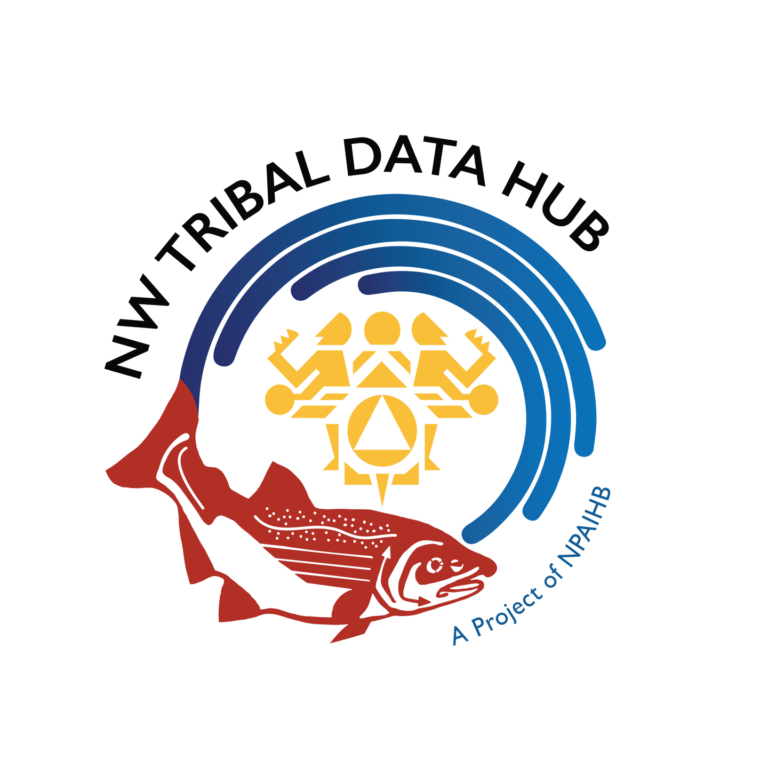
Salmon are born in the high mountain river systems of the Pacific Northwest and journey downriver to the Pacific Ocean. These small salmon benefit from the large ocean ecosystem, growing large from an abundance of marine nutrients. When adult salmon return to their natal waters to spawn they are bringing the essence of the Pacific Ocean with them. This marine subsidy provides nutrients to a new generation of salmon and every other organism in the riverine ecosystem. Salmon play a critical role by providing reciprocity between the marine environment and high mountain streams a thousand miles away.
Tribal communities are often left disconnected from the information generated by their people. Health data in the Pacific Northwest often leave Tribal communities through hospital, state, and federal systems, but rarely return to benefit Tribal communities. NWTEC works to access and analyze these health data on behalf of NPAIHB’s 43-member Tribes. The purpose of the NW Tribal Data Hub is to enhance the quality of data, by performing record linkages developing data insights, and returning usable data to its community of origin, much like the journey of salmon back to high mountain river systems. Data informs health policy and systems, communities, and leadership to improve health programming, develop funding proposals, and focus interventions to the community’s needs. The NW Tribal Data Hub provides reciprocity between tribal communities and their data. The NWTEC utilizes the NW Tribal Data Hub as a tool to ensure data complete their life-cycle, returning home to enrich the community by providing building blocks communities need to grow and thrive for future generations.
Salmon are born in the high mountain river systems of the Pacific Northwest and journey downriver to the Pacific Ocean. These small salmon benefit from the large ocean ecosystem, growing large from an abundance of marine nutrients. When adult salmon return to their natal waters to spawn they are bringing the essence of the Pacific Ocean with them. This marine subsidy provides nutrients to a new generation of salmon and every other organism in the riverine ecosystem. Salmon play a critical role by providing reciprocity between the marine environment and high mountain streams a thousand miles away.
Tribal communities are often left disconnected from the information generated by their people. Health data in the Pacific Northwest often leave Tribal communities through hospital, state, and federal systems, but rarely return to benefit Tribal communities. NWTEC works to access and analyze these health data on behalf of NPAIHB’s 43-member Tribes. The purpose of the NW Tribal Data Hub is to enhance the quality of data, by performing record linkages developing data insights, and returning usable data to its community of origin, much like the journey of salmon back to high mountain river systems. Data informs health policy and systems, communities, and leadership to improve health programming, develop funding proposals, and focus interventions to the community’s needs. The NW Tribal Data Hub provides reciprocity between tribal communities and their data. The NWTEC utilizes the NW Tribal Data Hub as a tool to ensure data complete their life-cycle, returning home to enrich the community by providing building blocks communities need to grow and thrive for future generations.